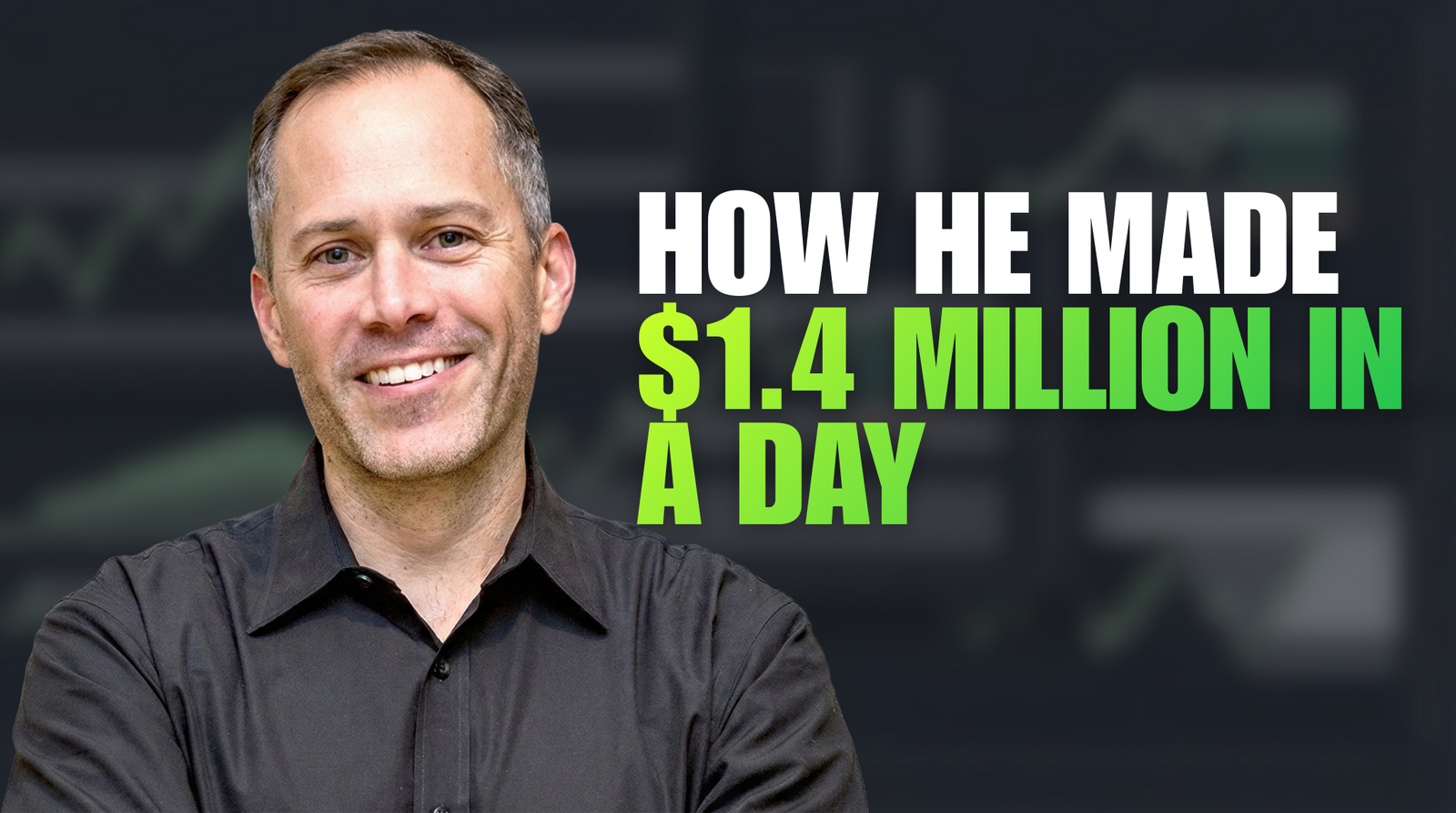
If you spend enough time around the markets, John Carter is a name you eventually run into. He is the guy behind Simpler Trading, boasting over twenty years of actual skin in the game.
He built his entire reputation on a pretty simple premise. He takes messy, complicated market noise and turns it into signals you can actually use. That is exactly where his famous “Squeeze” indicator came from.
Carter is known for being aggressive, but don’t mistake that for reckless. He is incredibly calculated with his swing trading, mostly in options and futures. And here is the kicker. Unlike so many educators out there, he is still in the trenches executing high-stakes trades himself.
This article takes a look at his evolution. We walk through how he went from that typical rookie cycle of fast wins and blown accounts to finding real professional consistency.
We also get into the nuts and bolts of his setups. We look at how he uses Fibonacci extensions to figure out exactly when to exit. Plus, we cover the risk rules that let him handle seven-figure positions in wild stocks like Tesla without blinking.
Overcoming the “Boom and Bust” Cycle
John Carter’s early days? They were messy. Defined by extreme ups and downs. He was stuck in this nasty loop where he would take a $10,000 account, run it all the way up to $100,000, and then lose every dime shortly after.
And he didn’t just do this once. He went through this specific “boom and bust” cycle three separate times.
The problem wasn’t that he didn’t know the markets. The flaw was his focus. He was obsessed with the monetary target of hitting a million dollars instead of focusing on the actual trading process.
The turning point finally came when he changed his headspace. This was heavily influenced by Mark Douglas and his book Trading in the Zone. Carter realized something huge. Consistency means you have to stop trying to predict the future.
He switched to a probabilistic mindset. He accepted that “anything can happen” in the market. This shift moved him away from the fear of losing and the arrogance of winning. It grounded him in execution rather than just the outcome.
At the core of this evolution was managing risk tolerance. Carter points out that successful trading is about walking a tightrope. You have to find that narrow path between paralyzing fear and reckless aggression.
He found that trying to force a trade to hit a financial goal always led to disaster. But when he focused on executing a professional plan? The profit just kind of happened. This mental pivot is what changed him from a gambler chasing a number into a trader managing risk.
The “Sweet Spot” Strategy
Carter eventually stepped away from the madness of the 5-minute charts. They were just too erratic for keeping capital safe consistently. Instead, he shifted his focus to hourly, daily, and weekly timeframes to find cleaner trends that cut through the intraday noise.
His “sweet spot” for holding a trade sits somewhere between two days and two weeks. This specific window lets him catch meaningful directional moves without the mental grind of day trading or tying up his money for months like a position trader.
The heart of his technical framework is “The Squeeze.” This setup is all about spotting periods of quiet consolidation where energy is building up before a massive release.
Technically speaking, the signal fires off when Bollinger Bands contract completely inside the Keltner Channels. The logic here is simple. Markets cycle between low volatility and high volatility. When those bands finally expand, that stored energy releases and drives a powerful directional move.
To actually trade this, Carter uses what he calls a “split-second” rule. He believes that if a trade setup doesn’t jump right off the screen at him in less than a second, it simply doesn’t exist.
Ambiguity is an immediate sign to walk away. He flips through charts at lightning speed, stopping only when the pattern is undeniable. This discipline is what filters out forced trades and ensures his capital only goes into the highest probability setups.
Harvesting “Low Hanging Fruit”
Carter operates on a pretty simple belief. Getting into a trade is actually the easy part. It is the exit that determines if you survive in this game long-term.
Here is where most traders screw up. They hold on way too long, hoping for that home run, and watch a nice green trade bleed into the red. To stop this from happening, Carter aims for the “low hanging fruit.” He wants the consistent, high-probability targets, not the absolute top or bottom of every single move.
His main tool for pinning down these exits is the Fibonacci extension. Specifically, he looks at the 1.272 level. By measuring the swing from a previous high to a low, or the other way around, he projects that 1.272 extension as the first target.
When price taps that level, Carter has a strict rule. He liquidates the majority of the position right there. Usually about 70% to 80%.
Once that cash is booked, he slides the stop loss on the remaining shares to breakeven. Now he has a “risk-free” trade. This lets him ride any potential extended run, maybe up to the 1.618 extension, without any emotional stress attached.
He also stacks this technical level against market maker data. He looks specifically at the “expected move” based on implied volatility options pricing. If a stock hits that 1.272 extension and simultaneously slams into its expected move for the week, Carter considers the odds of further upside to be basically zero. That is his cue to exit aggressively.
Instrument Selection: Why Options Over Futures
Carter leans heavily into options over futures, and it really comes down to one thing: defined risk.
Here is the problem with futures. A sharp, random volatility spike can smack your stop-loss and kick you out of a trade literally seconds before the market rips in the direction you predicted. It is frustrating. Options fix that. When you buy a contract, your risk is capped at the premium you paid. That allows you to weather those temporary moves against you without getting stopped out by noise.
A huge cornerstone of his strategy is financing trades to lower his exposure. He hardly ever just goes out and buys a naked directional call or put.
Instead, he builds spreads or diagonals. He buys a long-term, deep-in-the-money option and then sells a short-term, out-of-the-money option against it. The premium he collects from the short leg lowers the cost basis of the long position.
His ultimate goal is to get that cost basis down to zero, creating a “free trade.” Once the initial capital is paid back through selling that short-term premium, the remaining position is free of psychological pressure. He is basically forcing the market to pay for his trade. Plus, selling premium puts time decay—theta—on his side. It turns the depreciating nature of options from a liability into an asset.
Case Study: The $1.4 Million Tesla Trade
Let’s look at one of the wildest trades of his career. Back in January 2014, Carter pulled in roughly $1.4 million in just 24 hours. At the time, he was working with a $1.5 million account.
The setup was driven by a massive imbalance in sentiment. Tesla had a 40% short interest. Basically, nearly half the market was betting on the stock to crash. Carter recognized the dynamic immediately. Any sign of real strength would trigger a panic among the short sellers. They would be forced to buy back shares, pouring fuel on the fire and driving the price vertical.
The signal hit when Tesla opened down $10 but then reversed aggressively to trade up $5 on the day. That is a 15-point intraday swing. It screamed buying pressure.
Carter started scaling in aggressively. He bought 100 call options. Then another 100. Eventually, he built a massive position of 1,000 contracts. As the stock rallied, his open profit surged to $600,000. But a late-day pullback saw that number drop all the way to $300,000.
Despite a six-figure fluctuation that would make most people sick, he noticed the stock closed near its highs. That was the technical sign that momentum would likely carry into the next session.
He decided to hold half the position overnight. The decision paid off immediately. Tesla gapped up 10 points at the open the next morning. The short squeeze accelerated, and Carter liquidated the position right into the panic buying.
This trade highlights a critical piece of his philosophy. When a high-probability setup aligns with a macro imbalance, like high short interest, a professional trader has to have the conviction to size up aggressively to really maximize the return.
Conclusion
John Carter’s journey basically hands us a blueprint. It shows exactly how to move from amateur speculation to actual professional trading. The shift starts by dropping the “shotgun” approach. You simply cannot try to trade every asset class out there. Instead, you have to lock in on specific, repeatable setups like “The Squeeze.”
It requires the discipline to ignore the low-quality junk. You have to find the patience to wait for those “split-second” recognitions that signal a genuine opportunity.
At the end of the day, Carter’s success isn’t defined by predicting the future. It is about managing the probabilities of the present. By financing trades to reduce risk, targeting specific Fibonacci extensions for exits, and sizing up when market imbalances align, traders can navigate volatility rather than getting crushed by it. The goal isn’t just to make money. It is to develop a confidence in your skills that exists completely independently of the outcome of any single trade.